
Thumb Prison Release Paths
Someone leaving Thumb Correctional Facility can follow three main paths. A transfer moves the person to another Michigan Department of Corrections institution and does not end confinement. Parole permits prison exit to an approved community placement while MDOC jurisdiction and supervision continue. Maximum discharge ends the controlling sentence when parole did not occur earlier or when supervision later reaches its lawful end. The status and date fields in OTIS help distinguish these outcomes.
“Paroled” and “discharged” must not be used as synonyms. Date Paroled is retrospective evidence that the person left prison onto parole. Current parole status shows that supervision remains active. A discharge date or discharge certificate marks the end of MDOC jurisdiction. A change of location with prisoner status is usually a transfer. The statewide record should be read as a set of fields, not reduced to a single word such as released.
A transfer out of Thumb Correctional Facility is not a release; confirm current status and location before describing the outcome.
Confirm a Thumb Prison Release
The Michigan Department of Corrections Offender Tracking Information System, known as OTIS, is the primary public route for a Thumb Correctional Facility release. It covers current prisoners, parolees, probationers, and people discharged from MDOC supervision within the preceding three years. It does not cover county-jail-only cases. The broader Lapeer County release search explains when to change systems if the person was at the adjacent county jail instead.
- Open MDOC OTIS and choose Start Offender Search.
- Use the MDOC number when known, or enter the full name and available identity filters.
- Compare identifiers before opening a record. A name alone is not enough.
- Read Current Status and location first to separate prisoner, parolee, probationer, and discharged results.
- Compare Earliest Release Date, Maximum Discharge Date, Date Paroled, and supervision fields without treating a future date as completed release.
- Request the discharge certificate or other public MDOC record when documentary proof is needed.
OTIS can lag behind a transfer or processing event. MI-VINE may provide a general release alert, but an alert is not a certified record. When the result conflicts with a court judgment or supervision information, route court-derived errors to the sentencing court and supervision-related errors to the assigned field office.
Thumb Prison Records Contact
The facility contact establishes identity and can address published institutional information. It is not the public release locator. OTIS remains the first status route, while MDOC Records Retention handles requests for a paroled or discharged person’s available records. Ask for the specific public document needed, such as the discharge certificate, rather than assuming every part of a correctional packet is open.
Thumb Correctional Facility
3225 John Conley Drive
Lapeer, MI 48446
810-667-2045
mdoc-thumb-public@michigan.gov
MDOC Records Retention
517-780-5471
MDOC-Records_Retention@michigan.gov
MDOC’s FOIA process is a separate route for department records. A useful request includes the full name, MDOC number, date of birth if known, sentencing court, and approximate parole or discharge date. Ask for separable public portions if a larger file contains protected material.
Thumb Correctional Facility Profile
Thumb Correctional Facility is an MDOC Level II state prison for males age 18 and older. The official profile says it opened in 1987 and describes adult, youthful, Holmes Youthful Trainee Act, and medically frail units. These details identify the facility’s role. They do not create a local jail release route, and Lapeer County inmate extensions should not be used to check this prison population.
The official MDOC facility page supplies the correct institution identity and contact. The state source shown below should anchor any current facility detail.
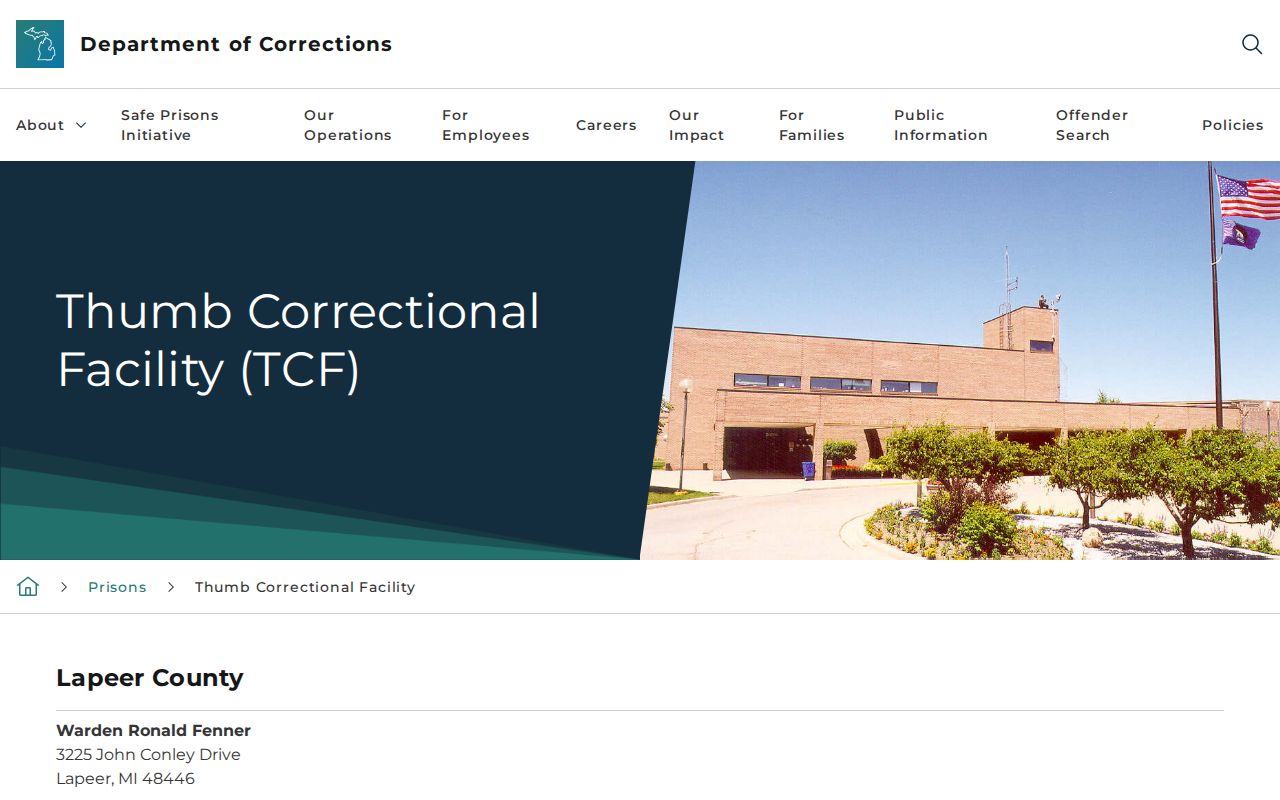
The profile confirms a state prison in Lapeer, while OTIS and MDOC records answer the separate release-status question.
Thumb Release Fields in OTIS
OTIS presents several date and status fields because Michigan prison sentences do not collapse into one guaranteed release date. The Earliest Release Date is generally the point when the Parole Board gains jurisdiction under the controlling minimum and applicable rules. It is eligibility, not a promise. Maximum Discharge Date is the outer sentence date if parole does not occur earlier, subject to the controlling sentence law.
| OTIS field | How to read it |
|---|---|
| Current Status | Whether the person is a prisoner, parolee, probationer, or discharged |
| Current or prior location | Whether Thumb still houses the person or MDOC moved the person |
| Earliest Release Date | Parole eligibility threshold, not an actual exit record |
| Maximum Discharge Date | Outer sentence endpoint under the displayed record |
| Date Paroled | Retrospective date of prison exit onto parole |
| Supervision Discharge Date | End of MDOC supervision when displayed |
A future date can change after resentencing, court correction, consecutive-sentence treatment, disciplinary time, parole action, or another lawful event. Preserve the search date and exact field labels when the result matters.
Thumb Prison Parole Status
The Michigan Parole Board is the sole paroling authority for felony offenders committed to MDOC. Eligibility does not create a right to leave Thumb Correctional Facility on the Earliest Release Date. The Board may grant, deny, or defer action, and a favorable decision can still require an approved placement and release coordination. Actual Date Paroled is therefore safer evidence that prison exit occurred.
Ordinary parole interviews are not published as a comprehensive public calendar. Public hearing notices generally concern matters that legally receive a public proceeding, such as clemency or qualifying life-sentence review. A hearing notice proves scheduling, not release. Quarterly decision reports are aggregate and cannot establish the result for one person. OTIS, direct notices available to an authorized recipient, and an appropriate records inquiry form the person-level trail.
Note: A parole grant can precede the physical exit while placement and release conditions are completed.
Thumb Discharge Record Requests
MDOC explains that a PENPACK for a paroled or discharged person may include certified copies of a presentence investigation report, basic information sheet, parole eligibility report, photograph when available, fingerprints, judgment of sentence, and discharge certificate. Access to every component is not assured. Presentence, victim, medical, security, and other protected information may be withheld.
The discharge certificate is stronger proof of the end of MDOC jurisdiction than a screenshot alone. Ask MDOC Records Retention for that certificate and public, separable portions of the packet. For proof of parole rather than full discharge, identify the Date Paroled and request the relevant public record. If the issue is a court-derived sentence field, contact the sentencing court because MDOC may require a court order before changing it.
Adjacent Lapeer Custody Systems
Thumb Correctional Facility and Lapeer County Jail stand next door at 3225 and 3231 John Conley Drive. That geography can make a search seem local when the records are not shared. Thumb is a state prison operated by MDOC. The jail is a county facility run by the sheriff. A Thumb prisoner has an MDOC number and state sentence record, while a county detainee has a local booking and court trail.
| Question | Thumb Correctional Facility | Lapeer County Jail |
|---|---|---|
| Current locator | MDOC OTIS | County inmate channel and jail phone |
| Exit record | Date Paroled or MDOC discharge certificate | Sheriff release sheet or jail register |
| Post-release status | MDOC parole or discharge | Depends on the court and receiving agency |
The similar address must never override the custodian. If the person moved from the jail to Thumb or another MDOC institution, the county event was a transfer and OTIS becomes the proper route after intake processing.
Thumb Release Alerts and Retention
MI-VINE can provide general release notification for MDOC prisoners. A user searches the matching person, checks that the reporting agency and facility are correct, and registers for the offered event. The alert can arrive before a public researcher notices an OTIS change, but it remains an agency-fed notification. Preserve the event details and confirm formal status with OTIS or an MDOC document.
OTIS retains people discharged from MDOC supervision for three years after the supervision-discharge date under its published scope. A person can therefore remain visible long after leaving Thumb and after parole ends. Once the public period expires, absence is not evidence that the person was never incarcerated or released. Older proof belongs with MDOC Records Retention, not the Lapeer County jail or an unsupported third-party listing.
For an important status check, save the MDOC number, exact status language, facility or assigned office, and the date searched. Match the result against the person’s identity details. If OTIS shows parole, the assigned location identifies the field office that controls supervision information. If it shows discharged, request the certificate when the end of jurisdiction must be documented. This record trail is more reliable than recalling an earlier screen after the public display changes.