
Lapeer County Release Meaning
A person is released from Lapeer County Jail when that jail’s physical custody ends. The next event matters. Someone may walk out after bond, a dismissal, or completion of a local sentence. Another person may leave the jail in the custody of the Michigan Department of Corrections, another county, a federal agency, or immigration authorities. Those events all remove a name from the local current-inmate channel, but only some are releases to the community.
The Lapeer County Sheriff’s Office keeps the local booking and release trail. A court file explains the order or case result behind an exit. MI-VINE may report a custody event. MDOC’s Offender Tracking Information System, known as OTIS, covers state prisoners and people under state parole or probation. A release inquiry should identify the custodian first, then match the record to that agency. One missing roster name is not enough.
Important: Leaving the Lapeer jail roster can mean community release or transfer. Confirm the release type and receiving agency before drawing a conclusion.
Lapeer County Release Types
Lapeer County release records use terms with distinct legal and practical meanings. The wording should be repeated as the agency gives it. A bond release does not end the case. Parole does not end an MDOC sentence. A transfer is not a community release, even though Lapeer County Jail custody has ended.
| Release type | What it means | Where to verify next |
|---|---|---|
| Bond or recognizance | Jail custody ends while the case remains open. | Jail release record, bond receipt, and 71A District Court docket |
| Time or sentence served | A local jail term ends after applicable credit and actual processing. | Sheriff release sheet and court judgment |
| Dismissal or acquittal | A case ends without conviction, though another hold may still exist. | Court disposition and jail record |
| Parole | A person leaves state prison under MDOC supervision. | OTIS status, date paroled, and assigned field office |
| Probation | A court orders supervision, which may occur without a prison release. | Probation order, OTIS, and assigned office |
| Transfer or detainer pickup | One custodian hands the person to another. | Jail movement record and receiving agency |
| MDOC discharge | State corrections jurisdiction ends at the controlling discharge point. | OTIS or an MDOC discharge certificate |
- Time served
- A sentence ends based on time already spent in custody and any lawful credit reflected by the responsible agency.
- Parole
- Conditional release from prison while MDOC supervision continues.
- Probation
- Court-ordered community supervision that is not proof of a prior prison term.
- Discharge
- The end of MDOC jurisdiction, which is different from the earlier date a person may have been paroled.
Lapeer County Release Record Fields
A strong local release record identifies one booking episode and shows when Lapeer County Jail custody ended. It may also identify why the person left and who accepted custody after a transfer. Not every field appears on one public screen. The jail register, release sheet, booking jacket, bond record, and movement history can hold different parts of the answer.
| Field | What it shows |
|---|---|
| Full name and identifying data | Links the record to the correct person instead of a same-name match. |
| Booking or offender number | Connects the release to one jail booking or state corrections file. |
| Booking date and time | Marks the start of that custody episode. |
| Releasing facility | Separates Lapeer County Jail from Thumb Correctional Facility or another custodian. |
| Release date and time | Records the physical exit processed by the holding agency. |
| Release authority or type | May identify bond, sentence completion, dismissal, parole, or another basis. |
| Court and case number | Points to the order, disposition, sentence, or bond trail. |
| Receiving agency or destination | Distinguishes a transfer from release to the community when recorded and releasable. |
| Supervision status | Shows whether parole or probation follows custody. |
| Booking photograph | Ties an image to the specific booking date when retained and public. |
Is a court order the release record? No. The order supplies legal authority, while the jail or MDOC record confirms the physical custody event.
Request Lapeer County Release Records
The Sheriff Records Division handles public information and county jail record requests. Its published hours are Monday through Friday, 8:00 a.m. to 4:00 p.m., with closure on most legal holidays. The county’s FOIA Coordinator can route a request when the record custodian is uncertain. Michigan FOIA applies to the sheriff and other local executive bodies, but it requires production of existing, nonexempt records rather than a new narrative or custom-built list.
- Identify the person with a full name, date of birth, booking number if known, and an approximate booking period.
- Use the county fillable FOIA form or the official online submission route. Name the Sheriff Records Division as custodian when appropriate.
- Ask for the booking sheet, jail-register entry, release sheet, release date and time, release authority, bond record, and receiving agency or transfer destination if recorded and releasable.
- Request electronic delivery and a good-faith fee estimate before costs exceed a stated limit. Allow for redaction, clarification, deposits, and lawful extensions.
- If no responsive record is found, ask whether the same data is stored as an inmate history, movement history, booking jacket, bond receipt, or transfer record.
Michigan generally requires a response notice within five business days, with one written extension of ten business days. That clock concerns the notice, not guaranteed production of all records. Allowable fees may include labor, copying, redaction work, and mailing. No fixed price for a Lapeer release record is published in the research, so the sound approach is to ask for an estimate.
The official Lapeer County FOIA page shows the routes, forms, and procedures used for county records.
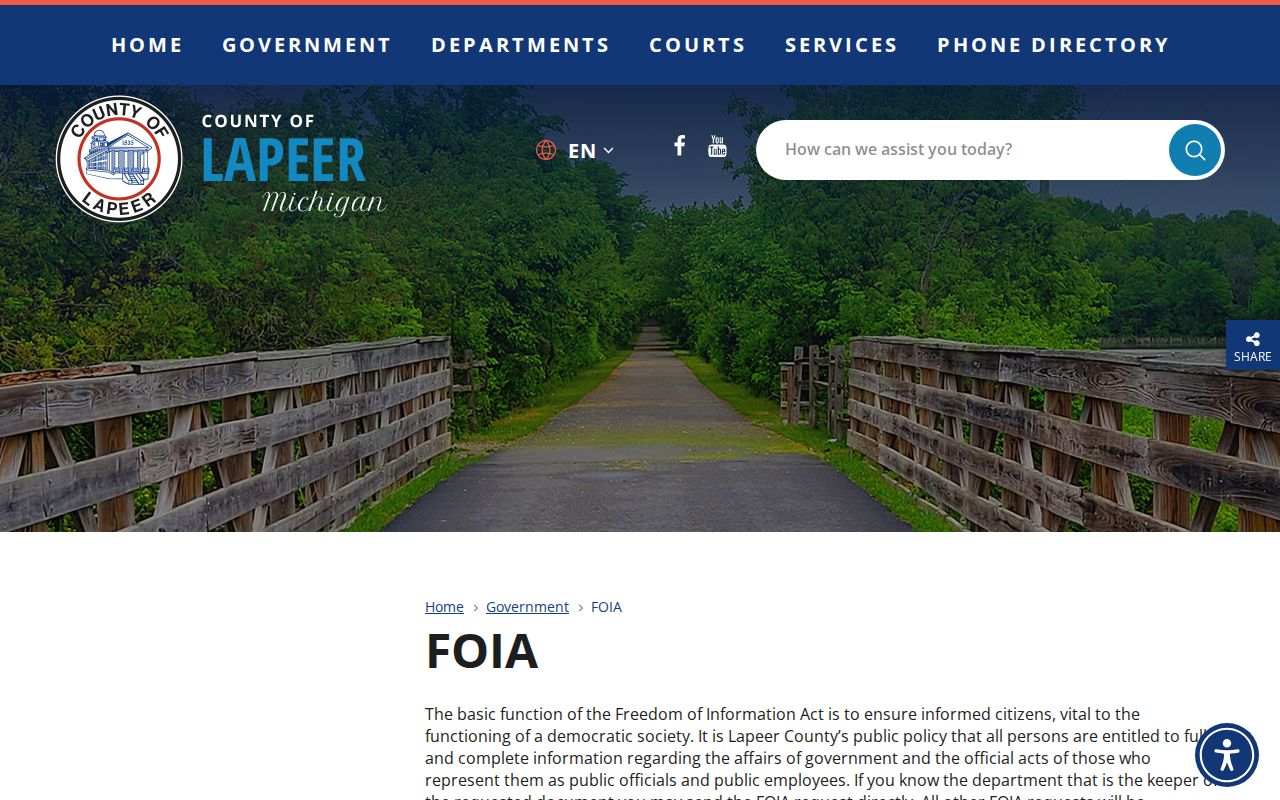
The captured county page helps a requester choose between a department request and central routing without treating a current jail list as an archive.
Note: Courts are outside Michigan FOIA when acting judicially, so court copies must be requested from the proper clerk under court-access rules.
Lapeer County Release Record Law
Michigan FOIA, MCL 15.231 et seq., governs access to nonexempt records held by the sheriff and MDOC. Security, medical, juvenile, sealed, and other protected content may be withheld or redacted. A request should seek separable public fields rather than assume that every part of a booking or corrections file is open.
Retention differs by system. Lapeer County does not promise how long a former detainee stays visible through its public current-inmate route. OTIS has a defined rule: discharged prisoners, parolees, and probationers remain public for three years after discharge from supervision under the framework in MCL 791.206a. Older state material may require an MDOC records request. Court retention varies by case and record type, so one blanket period would be inaccurate.
A Michigan set-aside can make a conviction nonpublic and may cause removal from OTIS or MiCOURT. Missing online data after a set-aside does not prove that no booking or release once occurred. Restricted material should remain private. An absence may also result from a database time limit, spelling issue, or different custodian.
Lapeer County Bond Release Steps
Lapeer’s Sheriff FAQ says cash bonds are accepted in the jail lobby at all hours, while credit and debit transactions use the lobby kiosk. A person may also post directly through the courthouse, which can avoid jail transaction fees. A surety agent must appear on the court-approved list. These are payment routes, not a promise that the person will walk out at once.
Bond begins with the court. The 71A District Court handles arraignment and decides bond eligibility, type, and amount in the early felony process as well as district matters. A bond order proves authority for release but not that money was posted or jail processing finished. Match the order to a receipt and the sheriff’s release timestamp. Another hold can prevent community release even after the bond in one case is satisfied.
When does release occur after bond? No official Lapeer source promises a set processing time. Confirm posting, check for other holds, and ask the jail when physical release was completed.
Lapeer County Release Property Rules
Property held by Lapeer County Jail is returned when a person is released. The official inmate information also draws a clear line between community release and a prison sentence. If a person is sentenced to prison, held property may be released to family rather than travel through the same ordinary release process. Unclaimed property is discarded after 90 days.
This property rule can help frame the right question. Ask whether the person left for the community, was transferred to MDOC, or had property released to an authorized family member. Property handling alone does not prove the legal basis or exact release time, but it can point to the correct record trail. The release sheet remains the better source for the custody event.
Lapeer County Release Lodging Fees
Lapeer’s official inmate billing page states that a qualifying straight-time sentence of five or more days carries a $35 daily baseline. An unsentenced person may also be billed for days the judge credits. The person’s inmate account balance is applied to the lodging bill on release, which makes the debt part of the local release process rather than a condition that vanishes with custody.
The published rate falls to $20 per day when the bill is paid or a payment plan is arranged within 30 days after release. Unresolved amounts may proceed to litigation or collection with added costs. Trustees are not charged room and board while in trustee status. These billing facts concern qualifying county jail stays, not a Thumb Correctional Facility sentence or an MDOC discharge. Questions go to the billing contact listed by the sheriff, not to OTIS or the court clerk.
Find Lapeer County Released Inmates
The most reliable lookup moves from the recent custodian to the record that lasts after a live list changes. Lapeer County does not publish a labeled 24-hour or 72-hour release web archive. The official jail route is current-custody oriented. That makes direct confirmation, MI-VINE, the courts, and a focused records request more useful than repeatedly checking for a vanished name.
- Start with the Lapeer County Sheriff’s current inmate channel or call 810-664-1801, extensions 2314 or 2315. Ask whether the person is present and, if absent, whether the exit was release or transfer.
- Search MI-VINE by name and identifying details for a reported county jail release, transfer, or escape event. Treat it as agency-fed notice, not a certified release sheet.
- Open MiCOURT and search the correct Lapeer court for bond, dismissal, judgment, sentence, commitment, probation, or later review entries.
- Use OTIS when a prison sentence, Thumb custody, parole, probation, or MDOC discharge is plausible. OTIS excludes county-jail-only sentences.
- Submit a Sheriff Records request for an older local event or when the release type and timestamp do not appear online.
- Use BOP or ICE only when the case actually involves federal or immigration custody. Neither replaces the sheriff, Michigan courts, or MDOC.
Compare more than a name. Date of birth, middle name, alias, booking or offender number, physical description, court, and charge help separate people with similar identities. Record the search date because custody and supervision data change. A negative result is a prompt to check spelling, time limits, agency scope, and nonpublic status, not proof that the person was never held.
Lapeer County OTIS Release Search
The MDOC OTIS search is the correct statewide source for someone who left Thumb Correctional Facility, entered MDOC after a Lapeer felony sentence, or remains under state parole or probation. It contains current prisoners, parolees, probationers, and people discharged within three years. It does not cover a person whose custody and sentence stayed only at Lapeer County Jail.
| OTIS field | How it helps a release lookup |
|---|---|
| First and last name | Starts a broad search when no MDOC number is known. |
| MDOC number | Provides the strongest public search key for one state offender. |
| Current status and location | Separates prisoner, parolee, probationer, and discharged records. |
| Earliest release date | Shows the first parole eligibility point, not a guaranteed exit. |
| Maximum discharge date | Shows the sentence endpoint if no earlier parole controls. |
| Date paroled | Documents when prison exit or parole status took effect. |
| Supervision discharge date | Marks the end of MDOC supervision when displayed. |
| Assigned location | Identifies the field office responsible for current supervision. |
Search by MDOC number when possible. Otherwise use the name and available identifying filters, then compare the full record before accepting a match. Read status and location before interpreting sentence dates. Michigan’s earliest release date is a parole eligibility point. The maximum discharge date answers a different question. Date Paroled is retrospective and is stronger proof of prison exit.
The official Michigan OTIS page shows the state search entry point and its stated scope.
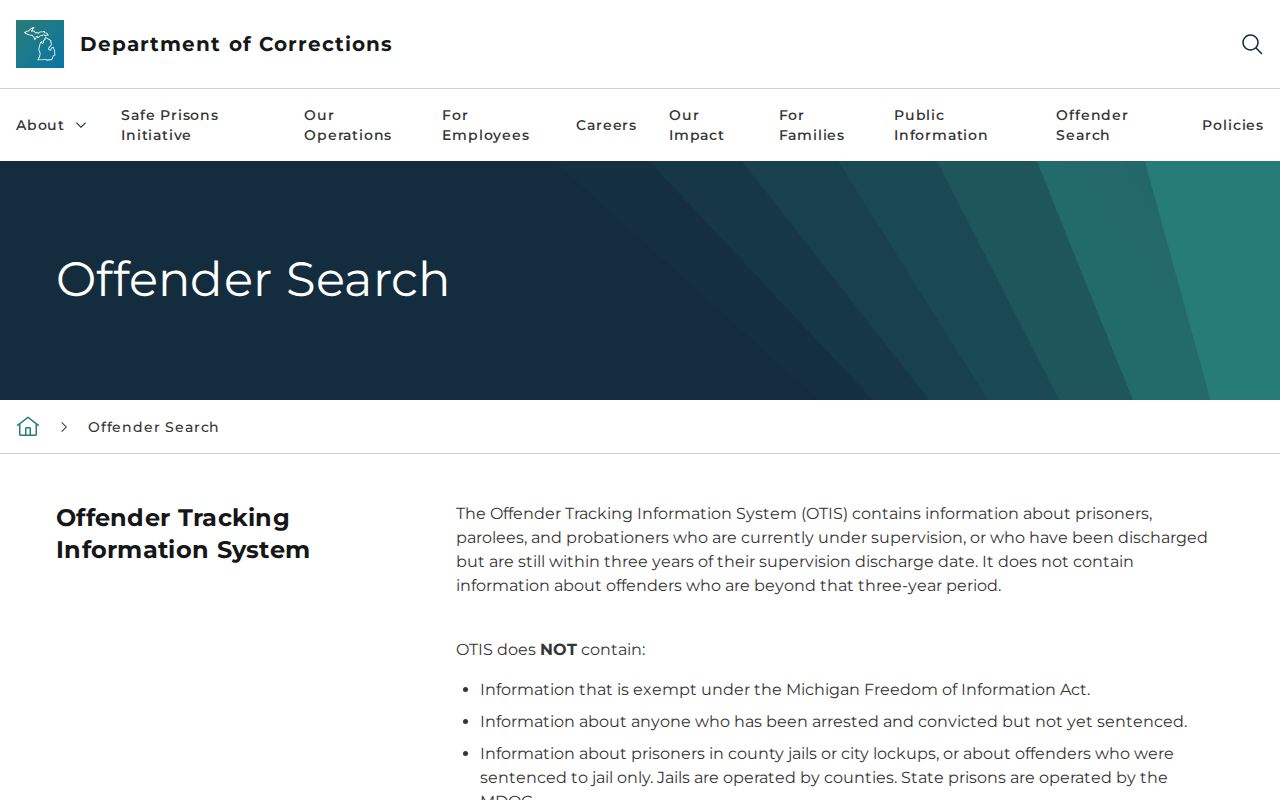
That scope warning is essential because the next-door county jail and state prison do not share one release database.
Lapeer County Release Court Trail
Lapeer felony cases can create a two-court trail. The 71A District Court handles arraignment, bond, and preliminary stages. After bindover, the 40th Circuit Court handles the felony disposition and sentence. A complete release inquiry may need both records because the first court can show why bond was set while the second shows the final judgment or prison commitment.
Search MiCOURT by participant name or case number and select the correct Lapeer courts. Review the register of actions, bond entries, disposition, judgment, sentence, jail credit, probation, and later orders. Online case data is informational, not the official court record. Ask the clerk for certified copies when formal proof matters. The jail record still supplies the physical release time.
Note: A court order may authorize release, but another case, warrant, or detainer can keep custody in place after that order.
Lapeer County Pre-Release Help
Lapeer County Jail’s rulebook provides a specific local planning option. A person expecting scheduled release may submit a written request at least 72 hours in advance for a call to 2-1-1. Corrections staff can also provide directories and referral help. This is a resource-navigation step, not an MDOC parole placement decision and not a public release list.
The timing matters. The rule applies before a scheduled release, so family members should not assume the call happens automatically or that it confirms the final exit date. A court order, sentence credit issue, or hold may still affect custody. The jail remains the source for the actual release event, while 2-1-1 can help the person identify local services and next steps.
Lapeer County Release Transportation
Greater Lapeer Transportation Authority is the public transit provider for the City of Lapeer and surrounding areas. No official source promises a jail stop or a ride coordinated with release. A person or family member should call the dial-a-ride number, 810-664-4566, and confirm service area, pickup point, and timing before relying on it.
Release processing does not follow a published daily schedule. Transportation should therefore be arranged with room for delay and with a clear pickup location confirmed by the jail. Thumb Correctional Facility has a separate MDOC release process, so plans made for a county jail exit should not be assumed to apply to a prison parole or discharge.
Lapeer County Release Detainers
An ICE detainer can change an expected Lapeer County community release into a custody handoff. Federal guidance describes a detainer as a request for notice and custody for up to 48 hours beyond the ordinary release point so the Department of Homeland Security can assume custody. If that occurs, county jail custody ends but the person is not free from confinement.
ICE’s Online Detainee Locator System searches by A-number and country of birth or by exact name and country of birth. Its documented scope includes current detainees and people released from ICE custody within the prior 60 days. No current ICE detention facility was identified in Lapeer County. That fact does not rule out a transfer elsewhere. Ask the jail which agency accepted custody and use the ICE locator for that distinct system.
Lapeer County Release Facility Mix
Lapeer County Jail and Thumb Correctional Facility are next-door neighbors at 3231 and 3225 John Conley Drive. Their physical closeness makes a mistaken search especially easy. The county jail is a 123-bed Sheriff’s Office facility for local pretrial, sentenced, and transfer cases. Thumb is an MDOC Level II state prison.
A county jail release is confirmed through the sheriff, MI-VINE, the Lapeer courts, and county records. A Thumb prison exit is confirmed through OTIS, MI-VINE, the Parole Board or assigned field office, and MDOC records. Transfer within MDOC is still prison custody. Parole is prison exit with supervision. Maximum discharge ends the sentence. Street address alone never identifies the correct record system.
Lapeer County Release Status Check
Each official system has a narrow role. The fastest accurate path is to decide whether the person was held by the county, MDOC, BOP, or ICE, then read that system’s status in context. The following comparison keeps current custody separate from a past release record.
Still in Lapeer County Jail: confirm through the current inmate channel or custody phone line. Released or transferred from that jail: use the sheriff’s release record, MI-VINE, and the court file.
In MDOC or released from state prison: use OTIS status, Date Paroled, discharge fields, and MDOC records. Federal or immigration custody: use BOP or ICE only when that custodian fits.
A BOP result marked released establishes only that BOP custody ended on the displayed date. It does not rule out supervision or another custodian. MI-VINE can provide timely notice but is not a certified archive. The Michigan Sex Offender Registry applies only to people legally required to register and does not provide a general release date for Lapeer County inmates.
Lapeer County Release Facilities
Two custodial institutions operate in Lapeer County, and each sends release questions to a different agency. Use the facility name and custody type before searching.
- Lapeer County Jail: community release may follow bond, sentence completion, dismissal, or another court-authorized event; other exits can lead to MDOC or another custodian.
- Thumb Correctional Facility: a person may parole to an approved placement, discharge at the maximum date, or transfer within MDOC.
The county jail current-inmate channel does not track people inside Thumb. OTIS does not contain jail-only Lapeer sentences. Confirming the operator prevents the most common local search error.