
Lapeer Release Mugshots and Records
A booking photo is an identification image made during a specific arrest and booking episode. Release does not change that history into a current-custody record. Michigan law, including MCL 28.241a, addresses law-enforcement capture of digital booking images in applicable circumstances. It does not order every sheriff to publish every image online. Public access therefore depends on which agency holds the photo, whether an official system displays it, the county’s record process, and any lawful exemption or nonpublic status.
Lapeer County’s public jail material is aimed at current inmate information. No official retained release-photo archive was located. A person may leave that current display while the Sheriff’s Office still holds a booking image tied to the jail record. The reverse is also possible: an image on another page may remain long after custody ended. The photo alone cannot prove release date, case outcome, guilt, current confinement, or supervision. Pair it with the booking number and date, release record, and court disposition.
Lapeer Released Mugshot Source Map
The source should match the custody system. A county booking photo comes from the Lapeer County Sheriff. An OTIS image is an MDOC offender photograph and may not be the county booking image. A registry photo serves a limited statutory registry, not a general release search. News and other copied images can point toward an event but carry less weight than an agency record.
| Channel | Has photo? | How to access |
|---|---|---|
| Sheriff current-inmate area or app | Possible, not promised after release | Inspect the official channel and confirm the booking details shown. |
| Sheriff Records or county FOIA | Request if retained and releasable | Identify the person, booking date, and booking number when known. |
| MDOC OTIS | Often, but some records lack an image | Search state prisoners, parolees, probationers, and recent discharges. |
| MDOC PENPACK request | May include an offender photo | Request public portions from Records Retention with the discharge record. |
| Michigan registry | Only for published registrants | Use solely when registry coverage applies; it is not a general inmate list. |
| Official agency news or local reporting | Sometimes event-specific | Confirm the image and disposition with the originating agency record. |
| Commercial or copied pages | May display an old copy | Treat only as an unverified lead; no commercial source is linked or endorsed. |
MI-VINE can help establish the reporting agency and custody event, but the research does not establish it as a stable booking-photo archive. The same caution applies to the sheriff app. A search result seen today may change after an agency update. If the correct image must be tied to a named booking episode, an agency response that includes the booking number and date is stronger than a screenshot without context.
Lapeer Sheriff App Photo Limits
Lapeer County operates official Android and iOS sheriff apps. The Sheriff FAQ points to an inmates area, making the app a legitimate current discovery channel. Yet the county and app-store material do not promise a released-person tab, a 24-hour or 72-hour filter, photo retention after release, an update pace, or an archive. Inspect the current app, note the date, and do not infer a feature from similar apps used by other counties.
The official Lapeer County Sheriff app listing identifies the county channel and its current description.
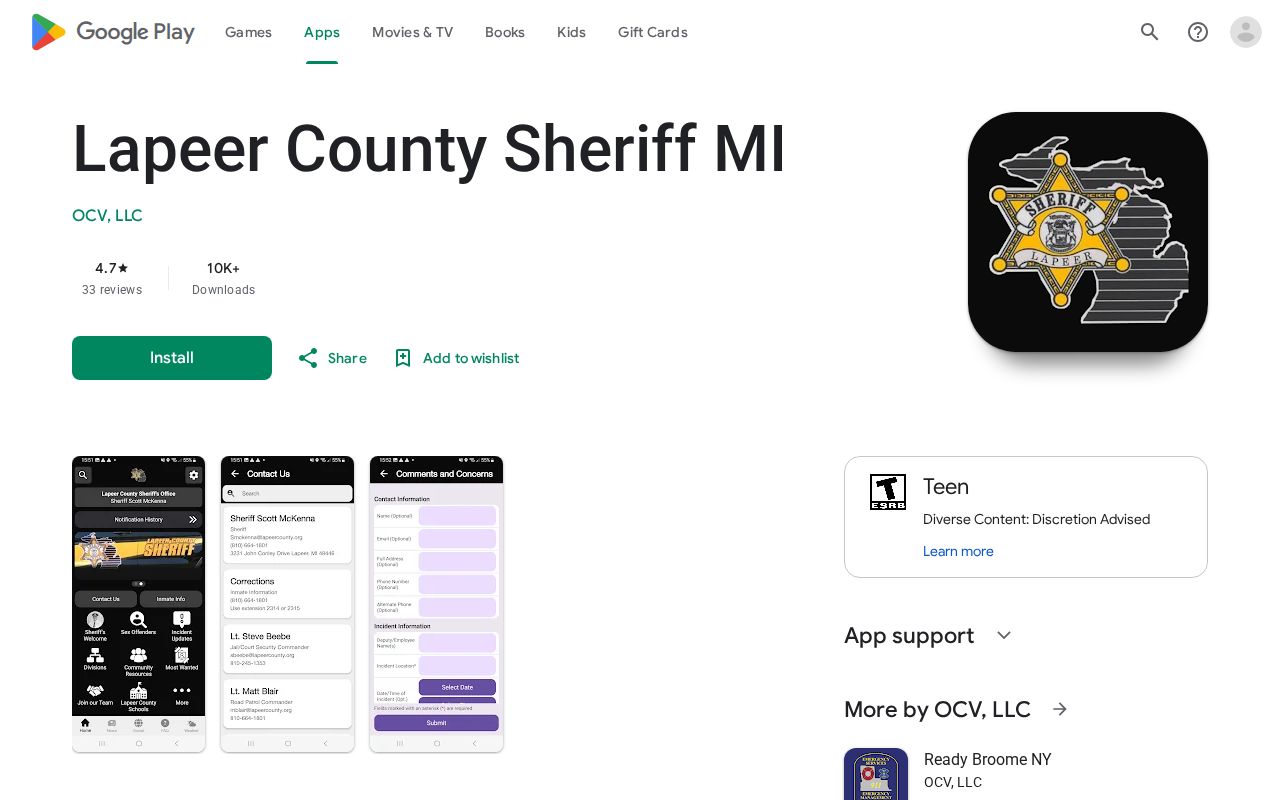
The image supports use of the official app as a place to inspect. It does not show that a released inmate’s booking photo will remain available or that an absent image was removed for a legal reason.
A person who no longer appears may have been released, transferred, or removed from the public view for another reason. Confirm the custody change separately. The Lapeer County 24-Hour Releases page gives the same-day verification chain when the photo search began with a recent jail event.
Note: App content can change without creating an archive, so record the date and verify the booking episode through Sheriff Records.
Request Lapeer County Booking Photos
The Sheriff Records Division handles public information and FOIA requests. The county FOIA hub allows a request to go directly to the department that keeps the record, while also offering a fillable form and an online route. Use Michigan FOIA, MCL 15.231 et seq., for executive and local public-body records such as sheriff-held booking material. Ask for an existing image. The law does not require staff to create a new photo, research an answer, or build a gallery.
- Identify the person with full name and date of birth, plus the Lapeer County Jail booking number if known.
- State the approximate booking date. One person can have several booking episodes and different images.
- Request the booking photograph and enough associated data to identify it, such as booking number and booking date.
- Ask whether the file is the original booking image or a later identification photograph. Request electronic delivery.
- Seek a fee estimate before charges exceed a set amount and ask for separable public portions if part of the record is exempt.
Mentioning the correct episode prevents an old image from being attached to a new event. The agency may charge allowable labor, copying, separation, redaction, or mailing costs. Michigan generally requires a response notice within five business days and permits one written ten-business-day extension. That is not a guarantee that a photo will be produced within five days. Deposits, scope, review, and redaction can affect actual timing.
Protected security, medical, juvenile, sealed, and other exempt information may be withheld. If the image is denied, keep the written exemption explanation and use the county’s published appeal process if appropriate. Do not replace the missing image with a photo from a different booking or person. For a wider named-person record path, use the Lapeer County released-inmate lookup.
Lapeer MDOC Release Photographs
Thumb Correctional Facility is an MDOC state prison in Lapeer, but its release and photo route is not the county-jail route. OTIS covers Michigan prisoners, parolees, probationers, and people discharged from MDOC supervision within the preceding three years. A public record can include a photograph when available, along with status, MDOC number, location, sentence information, parole or probation data, and discharge details. OTIS expressly excludes people whose custody was limited to a county jail.
An OTIS photograph is an offender identification image. It may not match the Lapeer County Jail booking photo from an earlier arrest. Some older MDOC records have no electronic picture, and display can end after the statutory post-discharge period or a qualifying set-aside. If stronger documentation is needed, MDOC Records Retention can provide available public portions of a PENPACK for a paroled or discharged person. That packet may include a discharge certificate and offender photograph, while protected sections may be withheld.
- Booking photo
- An image tied to a specific county arrest and jail intake.
- OTIS photo
- An MDOC offender image used within the state corrections record.
- PENPACK
- An MDOC record packet that may contain a discharge certificate, basic records, and an available photo.
- Discharge
- The end of MDOC jurisdiction, distinct from an earlier release on parole.
Lapeer Release Images in News
Official sheriff news or social posts and reputable local reporting may preserve an image connected to an arrest or public event. These sources are not systematic release ledgers. A story may omit a later dismissal, amended charge, sentence, transfer, or set-aside. Publication date is also not the booking or release date. Use the story as a lead to the agency and court record, not as proof of present status.
Commercial mugshot pages and copied databases are weaker. Their photos can be stale, mislabeled, detached from the case outcome, or copied without a clear source. No such page is linked here, and no paid removal service is endorsed. If a copied image appears, record the displayed source claim, compare the face and identifying data cautiously, then obtain the official booking record before drawing any conclusion. Never assume that search rank signals accuracy.
The Michigan Sex Offender Registry is another narrow channel. It provides photos only for people whose information is published under registry law. It is not a list of everyone released from the Lapeer County Jail or an MDOC prison. An absent registry result says nothing about most release events, while a registry result should be read only within its statutory purpose and current published fields.
Lapeer Mugshots After Set-Aside
Michigan’s conviction set-aside process can make qualifying conviction information nonpublic. Applications are filed in the court of conviction, and automatic Clean Slate rules can apply after the statutory conditions and waiting periods are met. OTIS states that a set-aside or expungement can cause a public record to be removed. A person’s disappearance from OTIS or MiCOURT may therefore reflect a legal access change rather than proof that no booking ever occurred.
A set-aside does not mean every copied image across the internet disappears at the same instant. Start with the official source. Provide the order or other documentation the agency asks for, identify the exact record, and use its correction or removal process. If a news outlet or other publisher still carries the image, contact that publisher under its stated policy. Do not pay or endorse a service that promises a result without first confirming the law, the source, and the scope of the set-aside.
The official statutory sweep found no Michigan-specific enacted anti-pay-to-remove mugshot law. That is a bounded research finding, not a claim that all publication or sales practices are lawful. MCL 28.241a governs specified booking-image capture but does not mandate universal internet publication. General privacy, court, FOIA-exemption, set-aside, and nonpublic-record rules can still control access in a given case.
Verify Lapeer Release Photo Identity
Photo discovery ends with source verification. Compare the full name, date of birth when lawfully available, booking or MDOC number, booking date, facility, court, and case number. Do not identify a person from facial similarity or name alone. Ask whether the photo comes from the county booking, MDOC, a registry, or a news release. Each source may show a different image from a different date.
Then separate the questions. The image answers which photograph was associated with a record. The jail release sheet answers when Lapeer County custody ended and whether another agency received the person. OTIS answers state-prison or supervision status. The court docket explains bond, disposition, and sentence. If those records conflict, preserve the exact wording and ask the originating office to correct its own record.
A durable citation should include the agency, system, identifier, and date accessed. Screenshots without that context can outlive the data that made them meaningful. Respect nonpublic changes. If a court or agency has lawfully restricted the record, an older copied photo is not a sound basis for republishing the event.