
Lapeer County Parole or Probation
Parole is supervised release from a Michigan prison. The person has left prison, but the Michigan Department of Corrections still has jurisdiction until parole ends or the sentence reaches discharge. Probation comes from a court order. A probationer may have served time in the Lapeer County Jail, but may also have received probation without a prison term. Michigan’s Field Operations Administration supervises both state parolees and probationers.
A county jail exit does not by itself create either status. Bond, dismissal, time served, and transfer are separate events. Start with the actual court and custody record. Then use the MDOC Offender Tracking Information System, known as OTIS, when state supervision is plausible. OTIS excludes people whose only sentence was in a county jail, so an empty OTIS result cannot disprove a local release.
| Point | Parole | Probation |
|---|---|---|
| How it begins | Release from an MDOC prison under Parole Board authority | A court orders supervision as part of the sentence |
| Custody history | Follows a state prison term | May follow jail, or may occur without prison |
| Main public check | OTIS current status, Date Paroled, and assigned location | OTIS status and assigned location, plus the court case |
| How it ends | MDOC discharge or sentence expiration | Completion or court-approved discharge |
- Parole
- Community supervision after release from state prison.
- Probation
- Court-ordered community supervision that does not require a prior prison term.
- Discharge
- The end of MDOC jurisdiction, not merely the day custody ended.
- Absconder
- A person alleged to have stopped reporting while supervision remains active.
Verify Lapeer County Post-Release Supervision
A sound check matches identity before interpreting status. OTIS can include prisoners, parolees, probationers, and people discharged from MDOC supervision within the prior three years. Search with offender status set to “ALL” when the person may have completed supervision. A failed name search can reflect spelling, an older discharge, a county-jail-only case, or a delay. It is not a final finding.
- Open OTIS and select Start Offender Search. Use the MDOC number when known because it is more exact than a name.
- Otherwise enter the last and first name. Compare the middle name, aliases, birth details, physical description, and offense before selecting a result.
- Read Current Status first. Prisoner, parolee, probationer, absconder, and discharged describe different points in the case.
- Review Supervision Begin Date, Supervision Discharge Date, Date Paroled, and Assigned Location. Do not turn an earliest release date into proof that release occurred.
- Open the assigned location to find the responsible field office. The office may differ from the county of conviction or former prison.
- For documentary proof, request the underlying MDOC record or check the sentencing court. Use the originating office when status or dates conflict.
The Lapeer County released-inmate search paths separate a county jail release from an MDOC event when the custody history is not yet clear.
Lapeer County Supervision Office
OTIS’s Assigned Location should control the office choice. The former prison, conviction court, and present supervision office can be in different counties. For a record assigned locally, the official MDOC Region 6 directory lists the Lapeer County Parole/Probation office. Region 6 also covers Genesee, Huron, Sanilac, Shiawassee, St. Clair, and Tuscola counties.
Lapeer County Parole/Probation
Michigan Department of Corrections, Region 6
255 Clay Street
Lapeer, MI 48446
Phone: 810-667-0221
The office is the right channel for supervision-related accuracy and assignment questions. It is not the source for a Lapeer County Jail release sheet. Court-derived errors should go to the sentencing court, while MDOC can correct its display when a court order or supervising agent supports the change. General OTIS accuracy concerns may also be sent to correctionsinfo@michigan.gov.
Here is the official Michigan Parole Board overview captured in the project research.
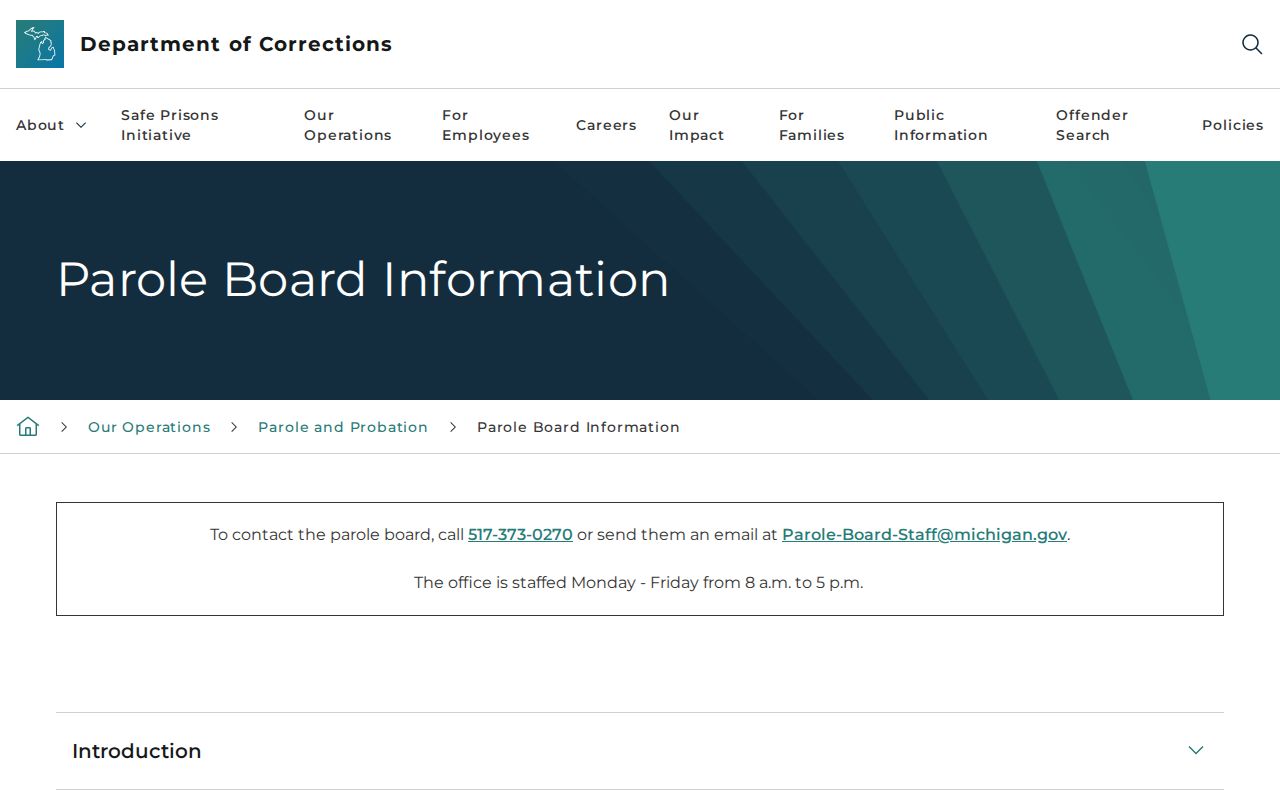
The source distinguishes the Board’s release authority from the field office’s later supervision role.
Note: Confirm office hours directly before visiting because the research documents the address and phone, but not a public walk-in schedule.
Lapeer County Parole Decision Trail
The Michigan Parole Board is the sole paroling authority for felony offenders committed to MDOC. Yet there is no complete public calendar of ordinary parole interviews. The MDOC public-hearing page mainly lists clemency and qualifying life-sentence proceedings. Its notices can prove that a public hearing was scheduled, but they do not prove the person was released.
A panel may grant, deny, or defer parole. A grant authorizes parole subject to the order, placement, conditions, and final release work. A denial keeps the person in prison and sets a later review point under the controlling decision. A deferral pauses action while more facts, programming, or placement work is developed. None of those labels should be rewritten as an accomplished release.
Quarterly Parole Board Decisions Reports contain aggregate counts and reasons. They cannot identify one Lapeer County person. For an individual result, compare available Board communication with OTIS Current Status and Date Paroled. The Parole Release Unit documents the parole date, term, special conditions, and approved community placement after a favorable decision. This interval explains why a grant date and an actual exit date may differ.
Lapeer County Supervision Violations
Conditions are the rules in a parole or probation order. They can address reporting, travel, treatment, contact, or other case-specific duties. The public research does not provide one universal set for every Lapeer County person, so the order and supervising office are the proper sources. A possible violation may prompt review, a warrant, a court event, or another custody action. It does not erase the existing supervision term.
OTIS supports absconder status searches. MDOC uses ABSCOND1 for a parole absconder actively sought after failing to report on time, and ABSCOND2 for a probation absconder under the sentencing county’s jurisdiction. An absconder remains under supervision. The term does not mean discharge, and a same-name result must not become an accusation without identity checks.
No public Lapeer Sheriff warrant or absconder list was found in the official navigation sweep. Check OTIS, the court, the assigned office, and law enforcement when appropriate. MDOC’s FAQ publishes an Absconder/Escapee Tip Line at 517-755-0855 for location information. A reported release alert alone does not resolve a later alleged supervision violation.
Lapeer County Release Resource Calls
Lapeer County has a local pre-release navigation step that is separate from MDOC parole placement. The county jail rulebook says a person may submit a written request at least 72 hours before a scheduled release for a call to 2-1-1. Corrections staff can also provide directories and referral help. This is a practical way to seek service information before leaving the jail.
That call does not create a parole placement, prove a release date, or assign an MDOC agent. A county jail detainee may use the resource process even when no state supervision follows. Conversely, a person leaving Thumb Correctional Facility on parole follows MDOC placement and field-office procedures. Keeping those paths separate prevents a local referral request from being mistaken for supervision status.
Thumb Area Regional Community Corrections adds another local layer. Its official programs include substance-use services, Thinking Matters, intensive supervision through Offender Success Management, and a residential option at TRI-CAP in Saginaw. The contacts listed are David Stevens at 810-245-4744 and Wendy Stevens at 810-245-4745. It supports community-based sanctions and programs, but it is not a public release-status database.
Lapeer County Release Property
Property handling offers a practical clue about the kind of exit that occurred. The official Lapeer inmate-information page says property held by the jail is returned upon release. If a person is sentenced to prison, property may instead be released to family. That distinction helps separate community release from a transfer into state custody.
Unclaimed property is discarded after 90 days under the published county information. A family trying to recover property should contact the jail promptly and confirm authorization rather than assume a roster disappearance means ordinary release. The property procedure is operational evidence, not a substitute for the release sheet, court order, or OTIS status.
Lapeer County Supervision Discharge
Discharge marks the end of MDOC jurisdiction. It is different from parole, which begins after prison exit and continues under supervision. OTIS can display Supervision Discharge Date and a discharged status. Michigan law keeps discharged prisoners, parolees, and probationers in the public system for three years after supervision discharge, subject to statutory limits and set-aside rules.
An older absence from OTIS does not prove that supervision never existed. The record may have aged beyond that public window, been affected by a set-aside, or require a different records route. When proof matters, request the MDOC discharge certificate or other underlying record. A court order can also be important for probation completion, but it should be read with the actual supervision record rather than used to guess at physical custody dates.
Read the final record in sequence. Date Paroled marks the move from prison into supervision. Supervision Discharge Date marks the later end of MDOC authority. For probation, the court case may contain the order that closes the term, while OTIS reflects the state supervision display. Keeping both dates prevents a person who has left custody but still reports to an agent from being described as fully discharged.
Note: Record the search date and exact status wording because parole, probation, absconder, and discharge describe materially different legal states.