
No Lapeer 72-Hour Release Feed
Lapeer County does not publish a documented 72-hour release list at the researched official URLs. The Sheriff’s corrections pages, current inmate-information route, frequently asked questions, site search, and mobile-app links were checked. None offers a page labeled as releases from the last three days. The county does not state a rolling window, refresh schedule, archive period, or set of public release-list columns. A three-day lookup therefore has to rebuild the timeline from the systems that produced each part of the event.
This absence has a narrow meaning. The sheriff may hold booking, movement, bond, and release records even though no public archive displays them. Current inmate information shows who may still be at the jail, not everyone who left during a chosen span. A name that disappeared on Friday could reflect bond, sentence completion, dismissal, transfer to MDOC, transfer to another county, or a federal or immigration handoff. Only the underlying record can identify which occurred.
Rebuild Lapeer County Three-Day Releases
Begin by fixing the date range. Write down the start and end time for the 72 hours being checked, including the time zone. Then compare current custody, agency alerts, and court entries across that same span. A same-day event can use the shorter Lapeer County 24-Hour Releases process. The wider method below is more useful when the possible exit day is uncertain or several nonbusiness days have passed.
- Check the official current-inmate channel. Call the Lapeer County Jail at 810-664-1801, extension 2314 or 2315, and ask whether the person remains there.
- Ask whether staff can confirm an exit date and whether it was community release or transfer. If another agency accepted custody, request the agency name.
- Search MI-VINE for a custody event supplied by a participating jail or corrections agency. Compare the reporting facility and identifying details.
- Search MiCOURT in both relevant Lapeer courts when the case is a felony trail. Review bond, dismissal, judgment, sentence, and commitment entries within the date window.
- Use OTIS if the records point to MDOC prison or supervision. A county-jail-only case will not appear in OTIS.
- Request the existing jail release sheet or movement history through Sheriff Records or county FOIA if the online and telephone checks do not document the event.
Keep each result tied to its source and search time. MI-VINE is prompt notification, but it is not a certified release ledger. A court order explains legal authority, yet the jail controls the physical exit timestamp. OTIS answers state-corrections questions after MDOC receives and enters a person. None should be used as a substitute for the others.
Lapeer 72-Hour Release Record Fields
No official Lapeer County three-day feed exists, so the county has not published a field inventory for one. These are the record elements that make a 72-hour reconstruction reliable. Ask for fields the sheriff actually holds rather than demand a new custom report. Some elements may sit in a booking sheet, release sheet, bond receipt, or movement record instead of one screen.
| Field | Use in a three-day check |
|---|---|
| Full name and booking number | Separates the booking episode from another person or earlier arrest. |
| Booking date and time | Places the start of county custody on the timeline. |
| Release date and time | Shows whether the exit falls within the selected 72 hours. |
| Release type or authority | Identifies bond, sentence expiration, dismissal, court order, or another basis when recorded. |
| Court and case number | Connects the jail event to the matching Lapeer docket. |
| Destination or receiving agency | Distinguishes going to the community from transfer to another custodian. |
Language matters. Bond release ends jail custody while the criminal case continues. A dismissed charge may explain release in one case while another hold remains. Transfer means a custodian changed, not that confinement ended. Parole concerns state-prison release into MDOC supervision. Discharge usually marks the end of MDOC jurisdiction. The release record’s exact phrase is safer than a broad label such as “got out.”
Note: Request the actual time field when the first or last day of the 72-hour window could change the answer.
Lapeer Weekend Release Reconstruction
A three-day view is most useful across a weekend because court activity, jail processing, and public record access can occur on different schedules. Lapeer County says cash bonds can be posted in the jail lobby around the clock, with card transactions handled through the lobby kiosk. That access does not guarantee a fixed release time. Staff may need to verify the bond, clear other holds, update the booking record, return property, and complete exit steps.
MiCOURT may show that a bond was set before the jail record shows it was posted and processed. MI-VINE may report the custody change after the supplying agency enters it. Records-office and court-clerk channels can have business-day hours even when jail operations continue. For a Friday-through-Monday question, note every event in order: court authorization, payment or other basis, jail processing, physical exit, and any transfer. The executed jail record closes the gap between an order and the actual release.
Holiday periods call for the same care. Do not shift the date merely because an online system changed later. Record the display time, but use the release timestamp supplied by the custodian. If a state-prison sentence appears in the court trail, county-list disappearance may precede OTIS visibility while MDOC completes reception and data entry.
Lapeer’s Other 72-Hour Rule
The county jail rulebook contains a separate 72-hour fact that can cause confusion. A person expecting a scheduled release may submit a written request no later than 72 hours before that release for telephone access to contact 2-1-1 about available resources. Corrections staff may also provide directories and referral help. This is a pre-release support process for the person in custody. It is not a public feed and does not reveal who left during the prior three days.
Keep the two uses apart. “Within the last 72 hours” describes the desired historical search window. “At least 72 hours before scheduled release” describes when an eligible person should request a resource call. The rulebook does not promise that all release dates are fixed three days ahead, nor does it state that the public can search scheduled releases. A pretrial detainee may leave after a bond event without the type of long-range schedule associated with a completed sentence.
Lapeer Releases and Custody Transfers
The most important question is not only whether Lapeer County custody ended. It is where the person went next. A community release may follow bond, dismissal, sentence completion, or another court-authorized event. A transfer can send the person to MDOC, another county, federal authorities, or immigration custody. Both outcomes remove the person from the county jail, but only one means the person left confinement.
| Clue | Likely next check | Limit |
|---|---|---|
| Absent from jail channel | Call jail and request release or transfer record | Absence alone proves no destination |
| Prison sentence in court | OTIS after MDOC reception | OTIS excludes county-jail-only custody |
| MI-VINE event | Confirm supplying agency and status | Notification can lag and is not certified |
| Bond or dismissal entry | Obtain jail exit time | Court action may precede processing |
A person transferred to Thumb Correctional Facility or another state prison becomes an MDOC search subject. A person released from Thumb on parole is also tracked through MDOC, not the county jail. The Lapeer County released-inmate lookup gives the full decision tree for a named person whose custody type is not yet known.
Request Lapeer Three-Day Records
When the public channels do not settle the date or destination, use the Sheriff Records Division and county FOIA process. The Records Division handles public information and FOIA requests. Requests may go to the department that keeps the record, through the county’s fillable form, or through its online form. Ask for an existing document linked to a named booking episode. Michigan FOIA does not require the sheriff to build a new 72-hour list if no such report already exists. The request can seek the booking sheet, jail-register entry, release sheet, release timestamp, release authority, receiving agency, bond record, and movement history if recorded and releasable. Provide full name, date of birth or booking number when known, and an approximate date range. Ask for electronic delivery and a fee estimate before charges exceed a stated cap. Allow for redaction of exempt security, medical, juvenile, sealed, or other protected material.
Michigan generally calls for a response notice within five business days, with one written ten-business-day extension available. That clock does not promise full production by the first response date. Scope, deposits, clarification, review, and separation of protected information can extend actual work. If the sheriff reports no responsive document, ask which unit keeps release sheets, movement histories, or bond receipts before concluding that no record exists.
The official Lapeer County inmate-information source shows why the fallback is needed. It is a live custody route, not a labeled three-day archive.
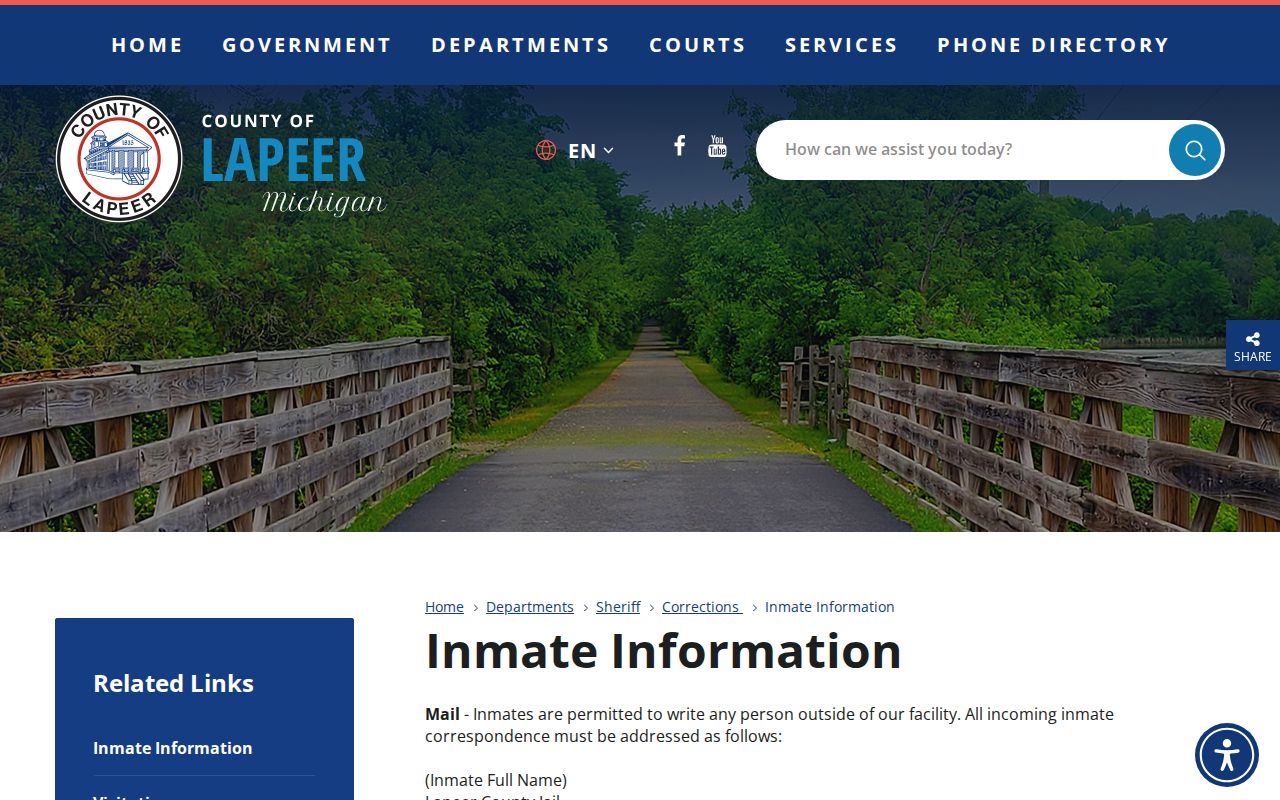
The captured page supports present-custody checking and direct contact. It does not supply a three-day release archive or a guaranteed release-history window.